Channel 3 Never Signed Off: Inside the Cable Access Archive That Won't Stop Broadcasting
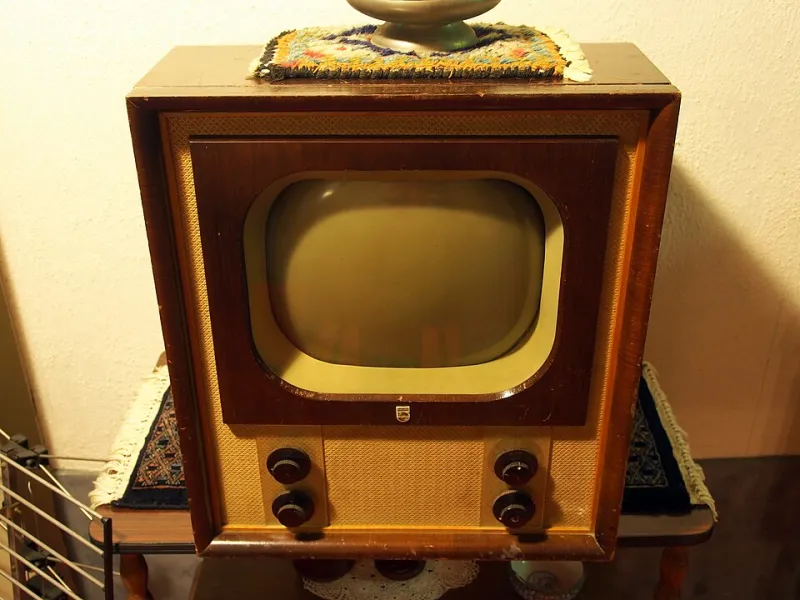
Photo: Alf van Beem, CC0, via Wikimedia Commons
The tape starts mid-sentence. Somebody is already talking. There's a couch, a banner across the bottom that reads in a font nobody would choose on purpose, and a phone number that has not been in service since the Clinton administration.
The host is asking a caller a question. The caller is not answering the question. The host keeps asking it, patiently, for what turns out to be ninety seconds of dead air with a live human on the other end. Then the caller hangs up. The host says "all right" and moves on.
This is public access television. It ran in thousands of American towns for decades on equipment that was legally required to exist, staffed by volunteers with no training and no budget and, crucially, no one to tell them no. And a small, scattered network of archivists is still pulling it off drives and out of closets in 2026, uploading it to audiences hundreds of miles from the towns that made it.
Appointment Television for Almost Nobody
Here's what people forget about access channels: they had timeslots. Real ones. A show about municipal water rates at 7:30 on Tuesday. A local band playing live at 11 p.m. A woman doing tarot readings for callers at 2 a.m. on a channel that otherwise showed a still image of a clock.
The audience was frequently in the single digits. That's not a failure state — that's the condition that produced the work. Nobody was optimizing for retention. There was no retention. There was a guy who had a slot and a camera and a thing he wanted to talk about.
Compare that to any modern platform, where the entire apparatus is designed to test whether you keep watching and to adjust accordingly. Access TV couldn't adjust. It didn't know who was watching. It just went out over the wire at the appointed time and hoped.
Who Actually Keeps This Stuff
The answer is: people who noticed too late and are now in a hurry.
Most access stations ran on tapes — three-quarter-inch, VHS, later MiniDV — and most of those tapes were taped over. That's the brutal fact of the format. Tape was expensive, storage was a shelf, and nobody in 1994 believed that a recording of a zoning board meeting had archival value. It got reused. It got thrown out when the station moved. It got left in a cabinet when the franchise agreement lapsed and the equipment got hauled away.
What survives, survives by accident. A volunteer who took tapes home. A station manager who couldn't bring himself to bin the last ten years. A city that stored boxes in a public works garage and forgot about them until a pipe burst.
The archivists working this material are a strange mix — retired broadcast engineers, local historians, and a younger cohort who got interested through the uploads themselves. They trade drives. They mail each other capture cards. There's a running conversation about how to stabilize a VHS transfer that has already been played so many times the tracking bar is permanent.
The Accidental Surrealism
What makes these broadcasts so watchable now is what made them unwatchable then: nothing was edited out.
A city council rant goes on for forty minutes because the speaker has forty minutes and the chair doesn't have a mechanism to stop him. A call-in psychic gets a wrong answer and then gets another wrong answer and you can hear her recalibrating in real time. A basement band plays four songs and the camera never moves because the camera operator is a volunteer who was told to hold still.
The edges are intact. Modern entertainment has been smoothed so thoroughly that we've almost lost the vocabulary for this — the long unfunny stretch, the technical error left in, the host who is visibly tired. Access TV was never smooth because smoothing costs money and nobody had any.
Why It Still Buffers
The archive is not complete and never will be. That's the honest state of it. What exists is a patchwork: a few hundred hours here, a scattered channel there, a lot of material that's been identified but not yet digitized because the machine that plays it costs more than the person who owns it can spend.
So it buffers. Literally and otherwise. Someone uploads a forty-year-old episode of a show that ran in one town for six months, and it finds an audience in a completely different state, and for a little while the algorithm has nothing to say about it. It's just there. A person, a camera, a clock in the corner, and no one telling anyone what to do next.
That's not a relic. That's the version of this whole medium before it learned to want something from you.