The Digits Don't Blink: A Late-Night Field Guide to America's Shortwave Ghost Signals
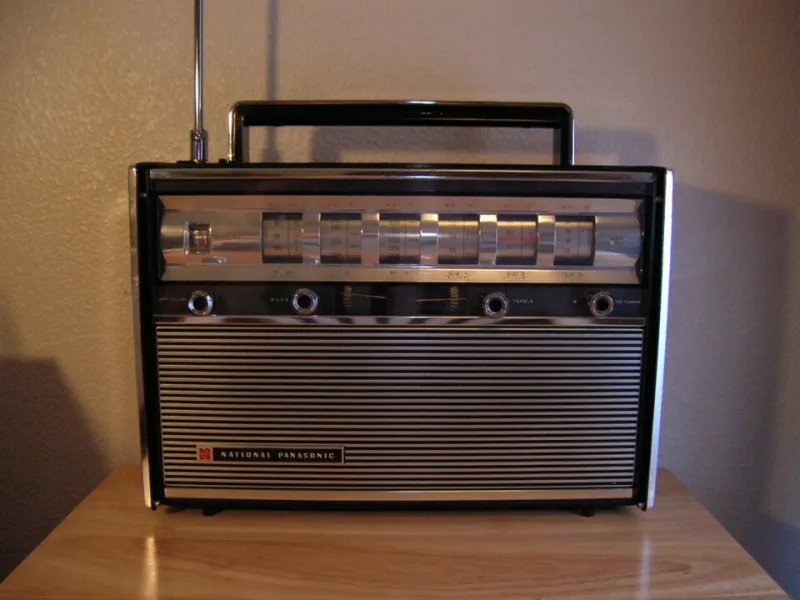
Photo: Junglecat at English Wikipedia, Public domain, via Wikimedia Commons
At 2:17 a.m., my kitchen table looks like a pawn shop for radio nerds: a portable shortwave receiver, a tangle of clip leads, a notebook, and a mug that has gone cold. I am listening to a frequency that a stranger on a forum promised would be busy. For six minutes, there is nothing but the soft hiss of the ionosphere. Then a woman's voice arrives, flat and unhurried. She reads digits. Three. Seven. Zero. One. Nine. She repeats them once, pauses, and moves on. No station ID. No music bed. No explanation. Then the carrier drops and the dark comes back.
This is a numbers station, or at least the thing hobbyists call one. For decades, shortwave radios have picked up anonymous broadcasts like this: strings of numbers, bursts of tones, sometimes a child's voice, sometimes a mechanical synth. They arrive on schedules that shift with the seasons. They vanish without sign-off. No one officially claims them. That is the point.
The Voice at 2:17 A.M.
Numbers stations are not a genre of entertainment. They are a genre of absence. You do not listen for a host or a story. You listen for the fact that someone, somewhere, went to the trouble of transmitting a message that almost no one is supposed to understand. The signal is public. The meaning is private. In a media landscape built on engagement, that is almost obscene.
The modern listener does not need a basement full of military surplus. A software-defined radio the size of a pack of cards can tune across the bands. Web-based receivers let you listen from a laptop in Arizona to an antenna in Europe. Forums and Discord servers trade schedules, frequencies, and recordings. Someone will post a clip at 3 a.m. with the caption: did anyone else catch this? The replies are a mix of technical chatter and pure vibes.
What the Digits Are (Probably) For
The honest answer is that no one outside the transmitting organization knows for sure. The leading theory is espionage. A one-time pad, used once and destroyed, is still one of the few encryption schemes that is mathematically unbreakable when handled correctly. Shortwave is cheap, borderless, and hard to trace. It leaves no server logs. It does not care about your IP address.
There are other theories: military communications, drug trafficking, embassy links, even elaborate hoaxes. A few cases over the years have nudged toward intelligence work, but no government has ever stood up and said, yes, that was us, here is the manual. The mystery is not a failure of research. It is the product.
American listeners hear plenty of these signals. Some originate far from US soil. A Cuban station that hobbyists know as HM01 has been a regular guest on the bands, its voice reading numbers in Spanish before a data burst. Other signals come and go with the ionosphere. The Buzzer, a Russian station with a cult following, has its own lore. But the appeal is not nationality. It is the ritual of tuning in and finding something that was never meant for you.
The Listeners
The people who track numbers stations are not usually trying to crack codes. They are archivists of the unexplained. They keep notebooks. They log start times. They compare recordings. They argue about whether a faint carrier is propagation or paranoia. Some are retired engineers. Some are insomniacs. Some are cryptography hobbyists who like the puzzle more than the answer.
A listener in Florida told me he keeps a radio by his bed because the bands are cleaner after midnight. He does not expect to decode anything. He likes the company of a voice that asks nothing back. Another, in Arizona, records every transmission she catches and uploads the files to a personal archive. She calls it a library of maybes. That is as good a description as any.
There is etiquette in the hobby. You do not jam. You do not transmit. You do not pretend to know more than you do. The community is small enough that reputation travels. The best listeners are the ones who admit when they heard nothing at all.
Why Analog Secrecy Still Works
In 2026, almost every digital message leaves a trail. Metadata, timestamps, account IDs, server logs. Even encrypted apps reveal who talked to whom and when. A shortwave broadcast reveals only that a transmitter was on. It is not secure in the way an encrypted messenger is secure. It is deniable. It is disposable. It is a public shout with a private meaning.
That is why the format survives. Not because it is efficient. Because it is stubborn. A numbers station can be received by a farmer with a battery radio, a spy with a portable set, or a hobbyist with a webSDR and too much time. The message does not care who is listening. It only cares who can read it.
There is also something seductive about a signal that cannot be recommended to you. No algorithm surfaces a numbers station. No feed predicts that you will enjoy it. You have to know where to look, and then you have to wait. In a web that is always trying to finish your sentence, the digits do not blink.
The Sign-Off
At 2:41 a.m., the voice stops. The carrier holds for a second, then folds into static. I write down the frequency and the time. I have no idea what it meant. I probably never will. That should be frustrating. Instead, it feels like a small clean thing in a messy world: a message that exists without asking me to click, share, subscribe, or care.
The static returns. Somewhere out there, another transmitter is warming up. The listeners will be ready. They always are.