The Handshake Heard Round the Cul-de-Sac: One Night on a Dial-Up Board That Won't Log Off
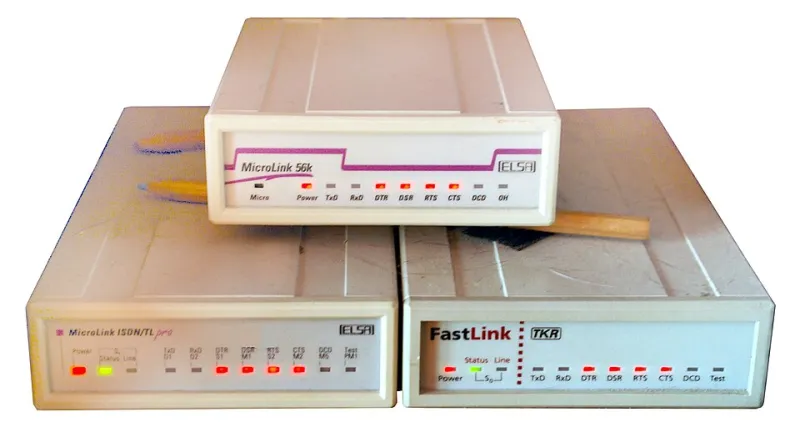
Photo: File:Elsa Modems IMGP0424.JPG: Johann H. Addicks - [email protected] derivative work: Pittigrilli, GFDL 1.2, via Wikimedia Commons
At 9:58 p.m., a phone line in a suburb outside Columbus, Ohio, rings once. Then again. On the other end, a modem picks up. The handshake begins: the screech, the hiss, the little electronic argument between two machines that have not met before. For anyone who grew up online before the web, the sound is a time machine. For the people who still call this board every night, it is just the front door.
The board is called The Night Owl. It runs on a machine that its sysop, a retired network administrator who goes by the handle Lantern, keeps in a closet next to the water heater. The software is old. The ANSI art is older. The message bases are active. In 2026, when most of the internet is a feed, The Night Owl is a room. You have to dial in. You have to wait. You have to type.
9:58 P.M., Busy Signal
Dial-up bulletin board systems were the social internet before the web made it easy. You called a number, your modem talked to another modem, and you landed in a text-based world of message boards, file libraries, and door games. For a lot of Americans, the BBS was the first place they ever posted under a handle. It was local. It was slow. It was a community bounded by a phone exchange.
Most of those boards died in the late 1990s. The web was faster, cheaper, and prettier. But a few survived. Some run on vintage hardware. Some run on emulators. Some are reachable over the internet through a Telnet bridge that simulates the old handshake. The Night Owl does both. Lantern keeps a real phone line for the purists and a bridge for the people who no longer own a modem.
Tonight, the board has twelve callers. That is a good night. The users are spread across time zones. A teacher in Oregon logs on after grading papers. A retired machinist in Michigan checks the trade board. A college student in Georgia found the board through a forum and now calls in from a terminal emulator on a laptop. They talk about weather, old computers, movies, and the strange satisfaction of waiting for a page to paint line by line.
The Board Behind the Screech
The Night Owl is not a museum piece. Lantern updates the software when it breaks. He moderates the message bases. He backs up the files. He pays for the phone line and the electricity. When I ask why, he says the board is a living room, not a monument. People still show up. That is reason enough.
The board has the usual rooms: a general message base, a tech help area, a file library full of shareware and text files, and a door games section where users play a turn-based space trading game that predates most of their accounts on modern social platforms. The interface is not intuitive. There are commands to learn. There is no infinite scroll. If you want to read a thread, you have to follow it.
That friction is the feature. On a BBS, you cannot doomscroll. You can only read what is in front of you, reply, and log off. The pace is deliberate. The conversation has edges. People say goodbye.
The Regulars
The regulars do not think of themselves as living in the past. They are not reenactors. They use modern phones and modern computers. They just like this particular corner of the internet better. One user tells me the board feels less performative than social media. There is no follower count. There is no algorithm deciding who gets seen. If you post something, it sits in a thread until someone replies. That is the whole system.
Another says the board is where he learned to write. He grew up in a rural county with one dial-up line and a local BBS. Now he lives in a city and calls The Night Owl from a laptop. The handshake is fake, he admits. The connection is simulated. But the room is real.
Why Keep It Running
Lantern is not sentimental about the technology. He does not insist that dial-up was better. He remembers the busy signals and the dropped connections. But he thinks something was lost when the web made everything instant and public. A BBS is a bounded space. You know who runs it. You know who is there. You know how to leave.
He also likes the maintenance. The board gives him a reason to keep old skills sharp. He can read a log file. He can troubleshoot a modem. He can explain to a confused caller why their terminal is sending the wrong line endings. It is a hobby with a pulse.
The Slow Web
At 11:20 p.m., the board is still busy. Someone has posted a long message about a broken tractor. Someone else has replied with a parts number. The door game has a new high score. The handshake has been replaced by the quiet click of a keyboard. It is not nostalgic. It is just slower.
The internet is full of places that want to be everything to everyone. The Night Owl wants to be a small room with a few regulars and a working phone line. That is not a business model. It is a way of being online. And for the people who call in, it is still worth the screech.