The Real Small Town Is Off the Feed: Notes From America's Invisible Internet
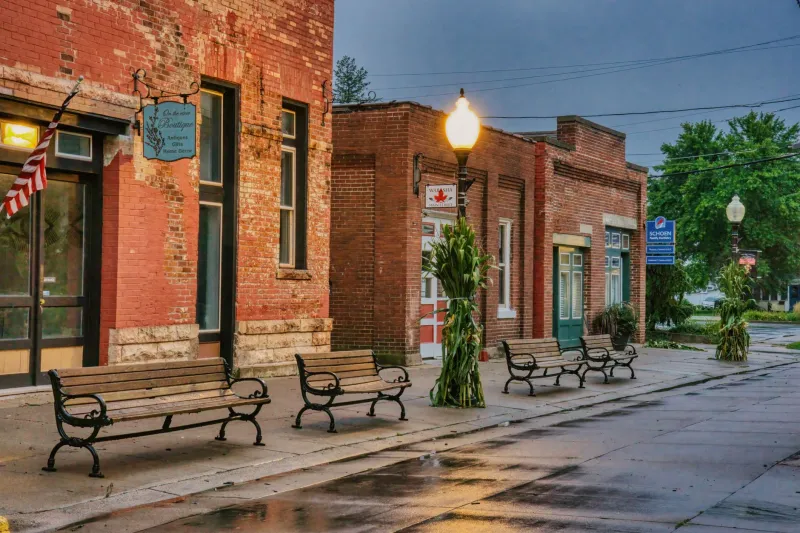
Here's a thing nobody tells you about small-town America: the version you can see online is the tourist brochure. The real one is buried three layers deep in a Facebook group you need to be approved to join, referenced obliquely in a Discord you didn't know existed, and settled in the comments of a review page run by a retired schoolteacher.
I've spent the last year poking at this hidden layer — call it the invisible internet of American localism — and I've come to a conclusion that'll annoy the civic-tech people: you cannot Google your way into a town. The internet that actually runs the place was built to keep you out.
The Layer Cake
Start with the obvious stratum: the public Facebook page. "Residents of [Town], IL" — 14,000 members, a profile photo of the water tower. This is the lobby. Tourists post here. Local reporters screenshot it. It is, functionally, theater.
One layer down is where things get interesting. The actual group, often with a deliberately boring name — "[County] Community Bulletin" — where membership requires a mutual friend or a convincing answer to "how do you know [name of local dentist]?" This is where the garage sales are real, the complaints about the new roundabout have teeth, and the school board drama is discussed with a fluency no newspaper could match.
Below that: the private Discords and group chats. These aren't about the town; they're run by the people who run the town, or at least by the people who decide what everyone thinks about it. The woman who organizes the parade route. The guy whose restaurant recommendations carry the weight of a Michelin star. A five-person chat that decided, over the course of a week, which of two competing coffee shops was "ours."
The Vernacular Review Economy
Forget Yelp. Every town has its own review infrastructure, and it doesn't look like a star rating. It looks like a comment thread under a photo of a casserole.
"Anyone eaten at the new place on Route 9?" is not a question. It's a referendum. And the responses — "we liked it fine," "the old location was better," a pointed silence where a certain family name should be — constitute the town's real dining guide. Outsiders read the Yelp page and wonder why the 4.2-star place is empty and the gas station with the taco window has a line. The answer is in the thread you weren't in.
Why It Stays Hidden
The instinct is to call this exclusionary, and sometimes it is. But mostly, it's load-bearing privacy. A town of 8,000 can't have a fully public opinion layer for the same reason it can't have a fully public water supply to every house — the plumbing has to be selective to work. People will say what they actually think about the new police chief in a group of neighbors, not under their full legal name in a forum indexed by a search engine.
There's also a defensive logic. After 2016, when hyperlocal Facebook groups became national news for all the wrong reasons, a lot of these communities deliberately went dark. Locked groups. Invite-only Discords. Vetting questions. The invisible internet isn't a relic — it's a bunker.
The Opinion Part
Here's where I'll plant a flag: the obsession with making communities "discoverable" is misplaced. Civic technologists keep building town apps and open data portals, and they keep wondering why nobody uses them. It's because the town already has an internet. It just doesn't want you in it — and that's not a bug to be fixed. It's the whole mechanism by which trust, gossip, and actual local decision-making operate.
If you want to understand an American small town, don't read its website. Get one mutual friend, answer the vetting question honestly, and then read quietly for six months. The real internet of a place is the one that never shows up in search results.
And honestly? Some rooms should stay that way.