The Payphone at the Edge of Town Still Knows Your Quarter's Weight
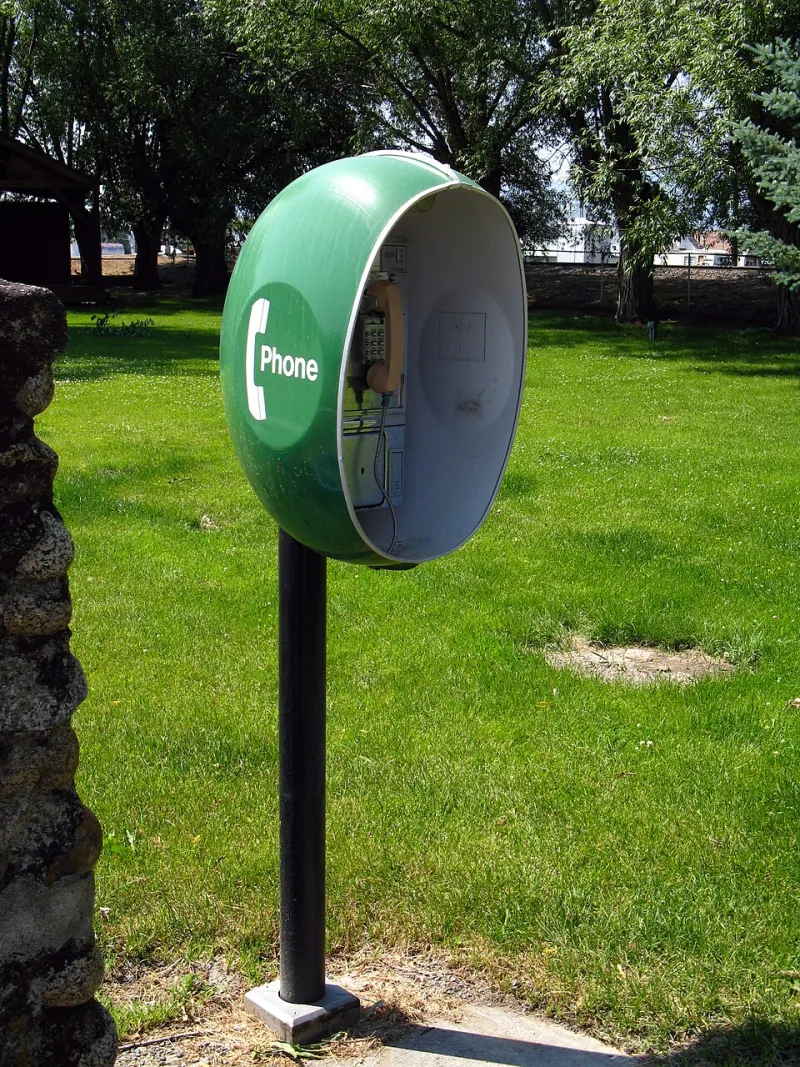
Photo: Publichall, CC BY 4.0, via Wikimedia Commons
There's a payphone outside a truck stop near Salina, Kansas, that still takes a quarter. It doesn't text. It doesn't ask for an email. It doesn't know your name. When it rings—and it does ring, maybe a few times a week—someone picks up. Usually it's nobody in particular. A driver killing time. A kid who found the number on a map. A person who just wanted to hear a phone ring in a place that wasn't a pocket.
The Map Is Not the Territory
A working payphone is now a landmark. Not in the way a courthouse or a water tower is a landmark—more like a stubborn weed in a parking lot. There is no national registry, no government list, no clean API. What exists instead is a patchwork of hobbyist maps: Google My Maps layers, a few wikis, a subreddit that updates every few weeks, and the memories of people who noticed a handset still bolted to a pole. The maps are always wrong. That's part of the appeal.
The mappers are not a unified movement. They're retirees with spreadsheets, phone phreaks with soldering irons, and road-trippers who pull over for anything bolted to concrete. They trade coordinates the way birders trade sightings. "Still live in Amarillo." "Handset cut, box humming." "Coin return jammed but dial tone works." The language is granular and unromantic, which is how you know it's real. Nobody is trying to monetize this. There's no ad tier for a payphone map.
What the Ring Is For
Calling a payphone is a strange act. You dial a number you found online, and somewhere in a town you've never visited, a bell goes off in public. If someone answers, you talk to a stranger about nothing. If nobody answers, you listen to the ring until it stops. Both outcomes are the point. The payphone is one of the last pieces of American infrastructure that doesn't care who you are, doesn't log your session, and doesn't try to sell you something before the call connects.
That anonymity is not a loophole. It's the feature. In an age when every public surface wants a login, a payphone is a room with no camera and no host. You can stand there for twenty minutes and be nobody. You can call a friend and say something you'd never type. You can call a stranger and ask what the weather is like. The transaction is cash, the record is a coin, and the rest is air.
The Maintenance Cult
Payphones survive because people fix them. Not officially—phone companies have been shedding these assets for years—but quietly, in garages and storage units. A retired lineman in Ohio keeps a box of handsets and keypads. A hobbyist in Portland rewires coin mechanisms for fun. A guy in Florida drives a route once a month and checks the ones he knows about. They are not preserving a business model. They are preserving a public object.
The repairs are improvised. A missing handset gets replaced with a salvaged one. A dead dial tone gets traced to a cut line. A coin jam gets cleared with a pocketknife. None of this is legal in the strict sense, and none of it is malicious. It's the same instinct that keeps a Little Free Library stocked or a trail cairn upright. Someone decided the thing should work, so they made it work.
The Last Public Room
Payphones persist in places where the grid is thin and the weather is rude: truck stops, ferry terminals, county fairgrounds, the corners of small-town courthouse squares. They are useful during hurricanes and cell outages, but that's not why people love them. People love them because they are unowned in the way a park bench is unowned. You don't have to be a customer. You don't have to be a member. You just have to be there.
The dial tone is a small, honest sound. It doesn't personalize. It doesn't predict. It doesn't know you were going to call. It just sits there, offering a line to nowhere in particular. If you find one, pick up. Drop a quarter if it asks. Listen to the ring. Somewhere on the other end, a public room is still open.